China’s aluminium laser cutting industry has moved from basic sheet processing to highly automated, precision-driven production. Manufacturers now serve automotive, aerospace, electronics, architecture, and custom fabrication markets. Yet selecting a reliable supplier requires more than comparing machine prices.
This guide examines China’s top 10 Aluminium Laser Cutting Machine manufacturers through practical and verifiable criteria. These include laser source quality, cutting speed, thermal control, machine rigidity, software integration, after-sales support, and export experience. A good machine should cut a 6 mm aluminium sheet cleanly, with limited dross around the edges. It should also maintain accuracy during long production shifts.
Theodore Maiman, the laser pioneer, once said, “The laser is a solution looking for a problem.” His words remain useful here. A powerful laser cannot correct poor material handling, weak calibration, or unsuitable cutting parameters. Small details matter. No list is perfect.
Therefore, this overview considers real workshop needs, not promotional claims alone. It looks at fiber laser platforms, automatic focusing systems, exchange tables, protective windows, and service response times. Manufacturer reputation is also checked against product documentation, certifications, installation records, and user feedback where available.
Some companies excel in high-volume production. Others offer better flexibility for small and medium workshops. A few still need stronger technical support outside China. That limitation deserves attention.
Readers can use this introduction as a starting point, then request test cuts before purchasing. Examine the edge finish yourself. Measure repeatability. Ask how quickly replacement parts arrive. In Aluminium Laser Cutting, dependable performance is often more valuable than an impressive specification sheet.
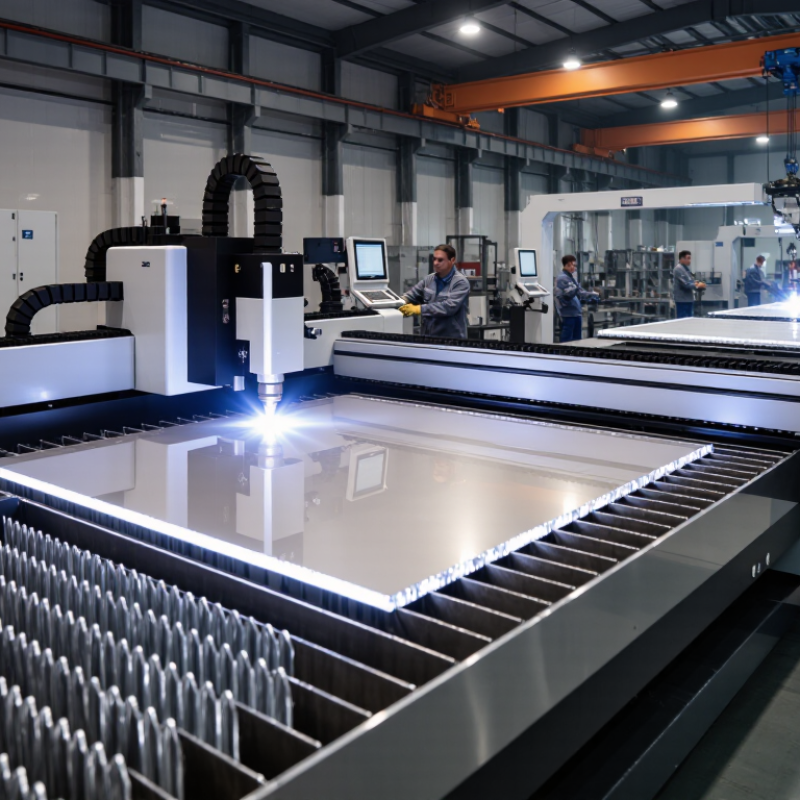
An aluminium laser cutting machine uses a focused light beam to slice aluminium sheets, plates, or profiles with controlled heat. A CNC system guides the cutting head along programmed paths. The beam melts a narrow section, while assist gas removes molten metal from the kerf. It is precise. Yet aluminium is not always easy to cut.
Aluminium reflects laser energy and conducts heat quickly. These properties can cause unstable piercing, rough edges, or small areas of dross. Modern machines usually combine a fiber laser source, a stable motion system, automatic height control, and suitable assist gas delivery. Cutting results depend on alloy, thickness, surface condition, power, speed, and focal position. A setting that works on a 6061 sheet may perform poorly on another alloy.
From practical workshop experience, operators should test a small section before full production. They should inspect edge color, burrs, squareness, and heat marks. Clean optics and accurate calibration also matter. Manufacturer specifications provide useful limits, but real material testing remains necessary. It is not magic. Even skilled technicians sometimes need several adjustments. Poor ventilation, incorrect gas pressure, or a worn nozzle can reduce quality without obvious warning. Safe operation requires guarding, trained personnel, regular maintenance, and documented cutting procedures.
| Anonymous Supplier Profile | Typical Machine Configuration | Fiber Laser Power | Standard Working Area | Typical Aluminium Cutting Capacity | Positioning Accuracy | Repeatability | Drive and Control System | Recommended Application |
|---|---|---|---|---|---|---|---|---|
| Profile 01 | Flatbed fiber laser cutter | 1.5–3 kW | 1,500 × 3,000 mm | 0.5–8 mm | ±0.03 mm/m | ±0.02 mm | Servo motors with CNC controller | General sheet-metal fabrication and small-batch aluminium parts |
| Profile 02 | Enclosed exchange-table fiber laser cutter | 2–4 kW | 1,500 × 3,000 mm | 0.5–10 mm | ±0.03 mm/m | ±0.02 mm | Dual-drive rack-and-pinion system | Electrical cabinets, enclosures, and precision aluminium panels |
| Profile 03 | Large-format flatbed laser cutter | 3–6 kW | 2,000 × 4,000 mm | 1–12 mm | ±0.04 mm/m | ±0.03 mm | Linear guideways with automatic height control | Architectural panels, transport components, and oversized sheets |
| Profile 04 | High-speed thin-sheet fiber laser cutter | 3–6 kW | 1,500 × 3,000 mm | 0.3–6 mm | ±0.02 mm/m | ±0.015 mm | High-speed servo platform with automatic nesting | High-volume production of thin aluminium components |
| Profile 05 | Heavy-duty fiber laser cutting machine | 6–12 kW | 2,000 × 6,000 mm | 2–20 mm | ±0.05 mm/m | ±0.04 mm | Reinforced gantry with dual-pinion transmission | Industrial frames, machinery parts, and thick aluminium plates |
| Profile 06 | Tube and sheet combination laser cutter | 2–6 kW | 1,500 × 3,000 mm | 0.5–10 mm sheet; up to Ø220 mm tube | ±0.04 mm/m | ±0.03 mm | Rotary chuck with CNC height sensing | Aluminium profiles, frames, tubes, and mixed-format production |
| Profile 07 | Automatic loading and unloading laser line | 3–6 kW | 1,500 × 3,000 mm | 0.5–12 mm | ±0.03 mm/m | ±0.02 mm | Motorized shuttle table and sheet-storage integration | Continuous production with reduced manual material handling |
| Profile 08 | Precision compact fiber laser cutter | 1–2 kW | 1,300 × 2,500 mm | 0.3–5 mm | ±0.02 mm/m | ±0.015 mm | Compact servo drive with closed-loop control | Prototype workshops, signage, lighting, and precision components |
| Profile 09 | Bevel-capable 3D fiber laser cutter | 6–12 kW | 2,000 × 4,000 mm | 1–16 mm | ±0.05 mm/m | ±0.04 mm | Multi-axis bevel head with automatic focus control | Weld-preparation edges, structural parts, and complex profiles |
| Profile 10 | High-power large-format fiber laser cutter | 12–20 kW | 2,500 × 6,000 mm | 2–25 mm | ±0.06 mm/m | ±0.05 mm | Heavy gantry, automatic gas control, and adaptive cutting software | Large aluminium plates, shipbuilding components, and heavy fabrication |
Aluminium reflects infrared energy and moves heat quickly. This can cause melting, distortion, or unstable piercing.
A suitable fiber source, precise autofocus, and a rigid cutting head help control reflected energy. Alignment still matters.
No. Poor gas flow can ruin thick-plate cuts, even with higher power. Settings need practical testing.
Nitrogen usually creates a bright, oxide-free edge. Compressed air may lower operating costs, but results can vary.
Keep the nozzle centered and clean. A small collision can create burrs or uneven edges.
Test the actual alloy, thickness, and tolerance. Record kerf width, dross, piercing time, and power consumption.
Training, calibration, spare optical parts, and response time affect long-term uptime. A powerful machine can still sit idle.
Efficient nesting reduces material waste. Height sensing, monitoring, cooling controls, and low-downtime maintenance support stable production.
Not completely. A polished sample may hide weak performance on thicker sheets or different alloys.
Verify testing scope, warranty terms, installation duties, safety documents, software compatibility, and spare-part availability. Rankings can change.
This article provides a practical guide to Aluminium Laser Cutting machines, explaining how focused laser energy can process aluminium sheets, plates, tubes, and profiles with speed and precision. It outlines the key features required for effective cutting, including suitable laser power, stable motion systems, accurate focusing, efficient cooling, reliable control software, and strong fume extraction. Readers will also learn how to evaluate Chinese manufacturers by examining machine configuration, cutting performance, quality control, technical support, customization options, warranty terms, and long-term service capability.
The article then presents a structured overview of China’s top 10 Aluminium Laser Cutting machine manufacturers without focusing on brand promotion. It also discusses common applications in fabrication, transportation, electronics, construction, and customized metalwork. Finally, it explains the main cost factors, such as machine specifications, automation level, auxiliary equipment, installation, and training, while highlighting essential maintenance practices that help preserve accuracy, reduce downtime, and extend equipment life.

 Lxshow